
Inflatable Slides: Commercial Buyer’s Guide
Commercial inflatable slides are large PVC structures powered by blowers that create repeatable, high-throughput rides for children, teens, and adults at commercial venues. These attractions appear as dry, water, giant, themed, and combo formats, used at events, party rental businesses, schools, amusement parks, malls, resorts, and municipal parks. Choosing the right commercial inflatable slide means balancing height, footprint, audience, safety, branding, and budget so the attraction fits both the site and the business model.
Inflatable slides sit near the top of the popularity chart for commercial inflatables because they combine visual impact with constant motion. They generate queues, laughter, and social content, which is exactly what schools, festivals, resorts, shopping malls, corporate family days, and rental fleets need. This guide explains what commercial inflatable slides are, how they are built, the main slide types, safety and installation essentials, key applications, selection criteria, branding options, and maintenance practices. It also outlines why experienced buyers often choose manufacturers such as Xtrafun Inflatables for long-term programs.
Well-planned slide programs reward brands, operators, and sponsors with repeat attendance and memorable experiences. The following sections walk through the technical and strategic decisions that turn an inflatable slide from a toy into a serious commercial asset.
Table of Contents
- Key Takeaways
- What Are Commercial Inflatable Slides And Why Do They Matter?
- What Types Of Inflatable Slides Are Best For Commercial Use?
- How Are Commercial Inflatable Slides Constructed? Materials, PVC, And Build Quality
- What Safety Standards And Installation Practices Should Buyers Expect?
- Where Do Inflatable Slides Deliver The Most Impact? Key Applications And Use Cases
- How To Choose The Right Commercial Inflatable Slide For Your Program
- How Do Custom Branding And Themed Designs Elevate Inflatable Slides?
- How Should Commercial Inflatable Slides Be Maintained, Cleaned, And Stored?
- Why Buy Commercial Inflatable Slides Directly From Xtrafun Inflatables?
- In Summary
- Frequently Asked Questions
- 12.1 Question – What Is The Difference Between Commercial Inflatable Slides And Residential Backyard Slides?
- 12.2 Question – How Do I Decide Between A Dry Inflatable Slide And An Inflatable Water Slide?
- 12.3 Question – What Slide Height Is Best For Schools Or Community Events?
- 12.4 Question – Can Commercial Inflatable Slides Be Used Both Wet And Dry?
- 12.5 Question – How Much Space Do I Need To Install A Commercial Inflatable Slide?
- 12.6 Question – What Kind Of Power Supply Do Inflatable Slides Require?
- 12.7 Question – How Long Does It Take To Set Up And Take Down A Commercial Inflatable Slide?
- 12.8 Question – How Do I Clean And Sanitize Inflatable Water Slides After Events?
- 12.9 Question – Can Inflatable Slides Be Custom-Branded With My Company’s Logos And Colors?
- 12.10 Question – Are Giant Inflatable Slides Safe For Teens And Adults?
- 12.11 Question – What Warranty Or After-Sales Support Should I Expect On Commercial Inflatable Slides?
- 12.12 Question – How Many Years Can A Commercial Inflatable Slide Last With Proper Care?
- 12.13 Question – Can Xtrafun Inflatables Export Slides Internationally For Multi-Country Campaigns?
Key Takeaways
Commercial buyers often want the highlights before reading a full guide, especially when evaluating inflatable slides alongside other attractions.
-
Commercial inflatable slides are heavy-duty PVC attractions designed for frequent public use rather than occasional backyard parties. They use industrial blowers, reinforced anchoring, and engineered safety features so schools, municipalities, and venues can run them confidently for long event days.
-
Key slide categories include dry, water, giant, themed, and combo models, each suited to specific sites and audiences. Rental fleets commonly mix compact backyard-friendly units with one or two giant inflatable slides that serve as premium offerings for city events and festivals.
-
Material quality, stitching, and structural design directly affect safety, uptime, and visual appearance over years of service. Buyers who focus on PVC thickness, non-slip surfaces, and documented manufacturing quality reduce breakdowns, complaints, and risk exposure.
-
Effective slide selection starts with audience profile, venue dimensions, climate, and branding needs. Decision-makers benefit from a structured checklist that covers height, lane count, wet or dry operation, capacity, and long-term maintenance before committing capital.
-
Custom branding and themed designs turn standard slides into large-format media for campaigns and sponsors. When those creative elements combine with strong manufacturing expertise, commercial slide programs support experiential marketing, revenue generation, and long-range brand building.
“Treat every inflatable slide as a long-term asset, not a disposable prop. Careful specification and maintenance will pay you back in safety, reliability, and repeat bookings.”
— Senior Product Consultant, Commercial Attractions Sector
What Are Commercial Inflatable Slides And Why Do They Matter?
Commercial inflatable slides are large air-supported structures built from heavy PVC for intensive use at events, venues, and attractions. They matter because they function as visual anchors, crowd magnets, and revenue assets for schools, municipalities, rental companies, and corporate brand teams. Compared with static signage or small games, a tall slide instantly signals activity, fun, and shared experience.
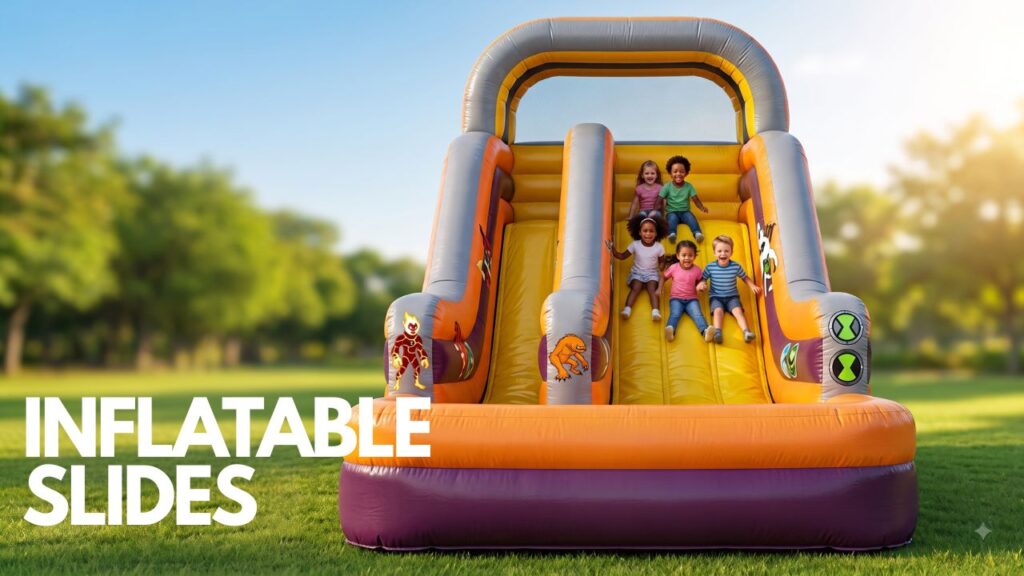
In technical terms, a commercial inflatable slide uses a continuous blower, internal baffles, and reinforced seams to maintain its form while people climb and descend repeatedly. Ladders or climbing walls lead to a guarded platform, followed by one or more slide lanes that end in a runout or splash pool. Sizes range from compact 13 to 16 foot units for school fields up to 30 foot and taller giants suited to fairgrounds, stadium fan zones, and beachfront parks. Because of these dimensional options, planners can integrate slides into small shopping mall atriums as easily as into sprawling municipal festivals.
Defining Commercial Inflatable Slides
Commercial inflatable slides differ from residential backyard inflatables in material grade, engineering margin, and regulatory expectations. A residential unit might use lighter PVC or even polyester fabric for occasional weekend use, while a commercial inflatable slide uses thick, PVC-coated vinyl with internal reinforcement mesh and multiple stitching rows. That construction carries higher purchase cost but delivers far greater durability under rental or venue conditions where hundreds of riders use the attraction each day.
Core components include:
-
The PVC inflatable slide body
-
One or more centrifugal blowers
-
Anchor points around the base
-
Climbing steps or walls
-
One or more slide lanes
-
A landing area or splash pool
Subcategories include inflatable dry slides for indoor arenas and cool seasons, inflatable water slides with water piping and pools for summer events, giant inflatable slides that reach 22 feet and above, and combo inflatables that add bounce or obstacle sections. Typical operating environments range from school grounds and church fields to mall atriums, resort pool decks, amusement park midways, and branded roadshow sites in city centers.
Strategic Benefits For Event And Venue Operators
From a business and marketing perspective, commercial inflatable slides help operators reach attendance, satisfaction, and sponsorship targets. The movement and height of a slide draw attention across a park or fairground, pulling visitors toward an area where concessions, sampling booths, or sponsor zones might sit. Longer dwell time near these zones often correlates with higher food and beverage sales or increased lead capture for corporate activations.
Slides also support experiential marketing goals because riders leave with a strong emotional association between physical excitement and the host brand. Photos and short videos captured on phones frequently show logos printed on slide sidewalls or headers, creating unforced social media impressions. Revenue models vary, including:
-
Direct per-ride ticketing
-
Bundled day passes
-
Inclusion in general admission
-
Sponsorship-backed free rides
Many operators add bouncy castles (including combo bouncy castles and inflatable jumper bouncy units), obstacle bouncy castles, and inflatable games bouncy attractions nearby, building a complete inflatable area that spreads participants across age groups and keeps families on site longer.
What Types Of Inflatable Slides Are Best For Commercial Use?
Commercial inflatable slides for events and venues fall into several repeatable formats that address different operational and marketing objectives. Selecting the right mix across dry, water, giant, themed, and combo models allows rental fleets, schools, resorts, and municipalities to serve varied audiences while keeping utilization high. Each format balances footprint, capacity, visual presence, and complexity in a distinct way.
For a mall running indoor promotions, a compact dry slide that fits safely under ceiling height works far better than a towering water unit that requires complex drainage planning. Conversely, a beachfront festival or resort pool might demand an 18 or 22 foot water slide that becomes the visual centerpiece of a summer campaign. Understanding these categories in detail prevents buyers from under-sizing a flagship attraction or over-specifying a slide for a tight site.
Core Categories: Dry, Water, Giant, Themed, And Combo Slides
Dry inflatable slides use non-slip climbing surfaces and standard slide vinyl without plumbed water features. They perform especially well in indoor arenas, convention centers, shopping malls, and cooler climates where water use is limited. Because they avoid hoses and pools, dry slides simplify logistics and clean-up while still providing fast descents and strong throughput for schools, corporate family days, and winter festivals.
Inflatable water slides add water piping at the top of the lane and drain into splash pools or shallow runouts. They dominate peak summer calendars at resorts, amusement parks, lakefront events, and rental bookings for backyard pool parties. Water reduces friction, increases perceived thrill, and supports heat-relief themes for beverage, snack, and outdoor apparel sponsors, a relationship explored in STEM research on slide design and speed that examines how surface and structural factors influence how fast riders travel down a slide. Many models function as wet or dry slides, which keeps utilization high across different seasons.
Giant inflatable slides, generally 22 feet tall and above, act as headline attractions for city festivals, stadium fan zones, municipal fairs, and large sponsor roadshows. They can carry two or three lanes, giving both high hourly capacity and a dramatic wall of color visible from significant distance.
Themed inflatable slides use sculpted shapes and printed graphics such as tropical islands, patriotic motifs, dinosaurs, fire trucks, or fantasy creatures to tap into specific demographics or holiday periods.
Inflatable combo slides blend a slide with a bounce area, climbing elements, or pop-up obstacles, which suits family audiences who want children to stay entertained in a single footprint.
Slide Type Comparison Table
The following table gives a high-level comparison of key commercial slide formats for specification and procurement planning.
| Slide Type | Typical Height | Best For | Seasonal Use | Relative Capacity | Branding Potential |
|---|---|---|---|---|---|
| Dry Slide | 13–20 ft | Schools, malls, indoor arenas, corporate gyms | Year round | Medium | High side panels |
| Water Slide | 15–24 ft | Resorts, parks, summer festivals, rentals | Warm months | High | Strong at pool end |
| Giant Event Slide | 22–30+ ft | Municipal events, stadium zones, sponsors | Seasonal | Very high | Landmark presence |
| Themed Slide | 15–24 ft | Family events, schools, themed festivals | Year round | Medium to high | Story-focused art |
| Combo Slide | 13–18 ft | Rental fleets, community centers, churches | Year round | High for footprint | Multiple zones |
Rental companies often maintain a balanced inventory that includes small inflatable playground slides for residential parties, one or two mid-range dual-lane water slides as revenue drivers, and at least one giant inflatable slide available for premium municipal or corporate bookings.
How Are Commercial Inflatable Slides Constructed? Materials, PVC, And Build Quality
Commercial inflatable slides rely on heavy materials, structural engineering, and quality control to withstand thousands of rider cycles. Construction choices determine whether a slide remains safe and visually appealing over years of rentals or venue use. PVC thickness, stitching patterns, internal baffles, and blower performance all influence load handling, stability, and resistance to UV, abrasion, and moisture.
Professional buyers differentiate PVC inflatable slides from cheaper units by checking specifications for fabric weight, coating, and seam techniques rather than appearance alone. A visually similar slide built from thin fabric with light stitching might sag, wrinkle, or tear quickly, while a properly engineered unit keeps sharp lines and stable surfaces even under heavy usage.
Heavy-Duty PVC, Reinforced Stitching, And Structural Design
Most serious commercial inflatable slides use PVC-coated vinyl reinforced with an internal polyester mesh. Heavier grades deliver high tear strength and puncture resistance, which is important when operating on grass fields, asphalt, or concrete surfaces. UV-resistant coatings help colors and printing stay vivid across multiple summers, which matters when logos and themed artwork are part of sponsorship packages or resort branding.
Key build features to look for include:
-
Heavy-duty PVC (commercial-grade thickness)
-
Reinforced stitching, often double or quadruple rows at stress points
-
Textured non-slip PVC on ladders and platforms, especially for wet use
-
Internal baffles and chambers that distribute air evenly
-
Industrial blowers matched to slide volume and height
Wet slides use textured non-slip PVC on ladders and platforms so crew and guests retain grip even when surfaces are damp. Internal baffles and chambers spread air evenly inside the body, preventing ballooning in one area while another section droops, a behavior confirmed by simulation research on inflation system performance that uses CFD modeling to analyze how ejecting inflation systems maintain structural form under pressure. Manufacturers that follow consistent engineering principles give buyers confidence that their commercial inflatable slide will meet professional expectations, an approach reflected in recent mechanical modeling of inflatable slide structures that examines how beam-truss coupled designs bend and respond under pressure. The catalog from Xtrafun Inflatables emphasizes this type of structural design across water and dry slide models.
Why Build Quality Protects Safety, Brand Image, And ROI
Superior construction has three direct impacts for commercial owners and operators:
-
Less downtime and lower repair costs
Thicker PVC and robust seams reduce day-to-day wear, which limits emergency repairs and keeps slides available during critical weekends and peak seasons. Rental fleets that avoid frequent downtime maintain better client satisfaction scores and capture more repeat bookings. -
Higher safety margins
A well-built slide supports safety through consistent geometry, stable walls, and predictable landing behavior, which reduces the probability of rider incidents that might lead to insurance claims or negative publicity. Parents, teachers, and risk managers quickly notice when an attraction feels saggy or poorly supported. -
Stronger brand image and sponsor value
Visual presentation ties directly to brand perception and sponsorship value. Faded graphics, stretched arches, and mismatched repairs reduce the professional image of a corporate activation or resort water zone. By prioritizing strong materials, premium blowers, and documented maintenance routines, operators stretch the usable life of each asset and keep total cost of ownership attractive compared with other experiential investments.
“The cheapest slide on day one is rarely the cheapest over five years. Material quality and stitching standards show up every time you run a major event.”
— Operations Director, Party Rental Group
What Safety Standards And Installation Practices Should Buyers Expect?
Commercial inflatable slides must meet modern safety expectations so that schools, municipalities, corporate sponsors, and insurers feel comfortable hosting large crowds. Properly designed units incorporate hardware features that manage falls, collisions, and falls from height, while operational practices cover anchoring, weather monitoring, supervision, and capacity control. Together, design and procedures keep inflatable event slides within the tolerance ranges expected by state regulators and standards bodies.
Buyers in the United States often reference guidelines from ASTM committees on amusement rides, including a published test method for on-water towable inflatables testing, even when their state does not formally regulate inflatables. Responsible suppliers provide manuals and training guidance so rental companies and venue teams install and operate equipment consistently. Safety is not a one-time check at purchase; it is an ongoing discipline that spans site selection, daily inspection, and staffing.
Built-In Safety Features And Compliance Considerations
Engineered safety features should be obvious when inspecting a commercial inflatable slide, and emerging research on hazardous behavior recognition in slide facilities shows how monitoring systems can help operators flag risky rider conduct before it leads to an incident. Important attributes include:
-
High side walls along each lane to contain riders
-
Protective netting or fabric barriers at the top platform
-
Clearly defined entry points with steps and handholds
-
Non-slip climbing surfaces and grab handles
-
Marked lanes to guide orderly flow, especially on multi-lane units
-
Anchoring systems with multiple D-rings and specified stakes or ballast
-
Safety placards listing age, height, and weight guidelines, plus behavior rules
Many school districts, malls, and cities require proof of insurance and periodic inspection records before allowing an inflatable attraction on site, so buyers should confirm that their supplier provides adequate documentation and guidance on local compliance.
Installation, Supervision, And Operational Checklists
Safe operation starts long before the blower is switched on. A structured approach helps crews install slides consistently.
Pre-setup checks
-
Evaluate the site for level ground and overhead obstructions.
-
Confirm no underground utilities will be affected by staking.
-
Plan access paths for equipment and emergency services.
Setup steps
-
Place tarps or ground covers.
-
Unroll the slide in the correct orientation.
-
Attach blowers to correctly rated circuits.
-
Inflate and visually check seams, ladders, and lanes.
-
Install anchors as specified in the manual.
-
Verify safety perimeter, barriers, and queue lines.
During operation
-
Keep at least one trained attendant at the base and, for larger slides, one at the top.
-
Enforce rider rules on height, weight, and safe body position.
-
Monitor weather conditions; suspend operations when wind or lightning thresholds are reached.
-
Conduct quick visual checks of anchors, blowers, and seams during quiet moments.
Post-event
-
Inspect for any damage or unusual wear.
-
Record issues in maintenance logs for repair planning.
Although operational details vary between models and venues, experienced manufacturers supply setup guides and safety documents that help teams integrate inflatable slides into their standard operating procedures.
Where Do Inflatable Slides Deliver The Most Impact? Key Applications And Use Cases
Commercial inflatable slides can support a broad spectrum of programs across education, civic life, retail, hospitality, and entertainment. Their impact comes from visible scale, crowd-drawing power, and the ability to integrate branding and sponsorship messages without feeling intrusive. When matched correctly to a venue and demographic, inflatable slides support both direct revenue goals and softer metrics such as community goodwill or brand affinity.
Different buyers prioritize different outcomes. A school district may focus on safe fun and fundraising for annual carnivals, while a mall targets foot traffic and dwell time. Resorts often concentrate on family satisfaction scores, whereas party rental companies watch booking rates and seasonal utilization. Recognizing these distinct objectives helps decision-makers choose slide formats that truly fit their context. In complex deployments, Xtrafun Inflatables often supports clients with mixes of slides and complementary items that fit each property.
Sector-Specific Applications (Schools, Festivals, Malls, Resorts, And More)
Schools and municipalities
-
Use inflatable slides at sports days, fun fairs, and community celebrations.
-
Prefer moderate-height dry slides or water slides in the 13 to 18 foot range.
-
Combine slides with bouncy castles and inflatable games bouncy activities to keep various age groups entertained.
Festivals, races, and corporate events
-
Lean toward giant inflatable slides that can be seen across fairgrounds or finish areas.
-
Use dual and triple-lane models to handle high volumes and support race formats.
-
Integrate sponsor branding on sidewalls, arches, and splash pools.
Shopping malls and retail centers
-
Operate dry slides inside atriums for school holidays and weekends.
-
Reserve inflatable water slides for outdoor parking lot promotions in warm seasons.
-
Pair slides with combo bouncy castles and themed decor to create pop-up family zones.
Resorts, hotels, and amusement parks
-
Integrate inflatable water slides into pool decks or mini waterparks.
-
Add themed elements that match the property’s visual identity.
-
Use slides alongside obstacle bouncy castles and inflatable mini bouncy units to cater to a full age range.
Party rental businesses
-
Build tiered fleets, with compact slides for backyard birthdays.
-
Offer larger water slides and giant dry slides for company picnics, church gatherings, or municipal contracts.
-
Cross-sell with bouncy castles and inflatable jumper bouncy units for all-day packages.
Building Immersive Zones With Complementary Inflatables
Slides rarely operate in isolation at larger events and venues. Operators often build immersive zones by combining inflatable playground slides with:
-
Commercial bouncy castles as central bounce areas
-
Inflatable mini bouncy units for toddlers
-
Obstacle bouncy castles for older children and teenagers
-
Inflatable games bouncy challenges for family competition
This mix spreads traffic across attractions, balances age ranges, and supports longer guest stays in one area.
Corporate brand activations, sports fan zones, and city festivals frequently layer arches, tunnels, and product-replica inflatables around a central slide. That structure allows organizers to lead guests through a story that might begin under a sponsor arch, continue through an obstacle section, and finish with a race down a dual-lane slide. When designed cohesively, these multi-asset zones give sponsors more surfaces for logos and messages without clutter, raising the perceived value of commercial packages.
How To Choose The Right Commercial Inflatable Slide For Your Program
Choosing the right commercial inflatable slide involves more than picking a favorite design from a catalog. Decision-makers must balance audience profile, venue limitations, operating climate, staffing capacity, and long-range financial goals. A slide that excels as a resort centerpiece might be poorly suited to a mall atrium, while an 18 foot dual-lane water slide could overwhelm a small school courtyard yet perform perfectly on a municipal field.
An organized evaluation process helps prevent under-specification, such as buying a slide that feels underwhelming at a city festival, or over-investment in a giant slide that rarely fits available sites. Commercial buyers should also consider whether they want inflatable slides for sale as permanent assets or prefer to rent for individual events. Manufacturers such as Xtrafun Inflatables can advise on archetype selections that match specific programs.
Decision Criteria And Comparison Table
Practical decision criteria fall into several clusters.
Physical factors
-
Overall height and perceived thrill
-
Footprint, including runout and queue area
-
Lane count (single, dual, or triple)
Functional choices
-
Dry vs. water operation
-
Wet/dry compatibility
-
Pool or slip section options
Aesthetic decisions
-
Neutral vs. themed designs
-
Available branding surfaces for logos and sponsors
Operational aspects
-
Power demands and blower count
-
Installation complexity and setup time
-
Cleaning routines and staff skill level
The table below compares three representative commercial inflatable slide purchases.
| Archetype | Ideal Buyers | Typical Venues | Audience Range | Pros | Cons |
|---|---|---|---|---|---|
| Compact Dry Slide (15 ft) | Schools, malls, small rentals | Gyms, atriums, backyards | Children to preteens | Fits tight spaces; simpler logistics; year round use | Lower visual impact; single-lane capacity |
| Mid-Size Dual-Lane Water Slide (18 ft) | Rental fleets, resorts, municipalities | Parks, pool decks, festivals | Children to adults | Strong presence; good throughput; wet or dry operation | Seasonal limits in cold regions |
| Giant Themed Event Slide (22–24 ft) | Cities, sponsors, stadiums | Fairgrounds, fan zones, beaches | Older children, teens, adults | Landmark visibility; sponsorship appeal; high capacity | Requires large site; higher staffing need |
As a rule of thumb:
-
Schools, churches, and malls lean toward compact dry slides or mid-size units.
-
Resorts and amusement parks gravitate to mid-size and giant water slides.
-
Rental fleets often start with the 18 foot dual-lane archetype and expand upward as demand for municipal and corporate events grows.
Buying Checklist And Expert Recommendations
A structured checklist keeps purchasing conversations focused and objective.
-
Define core use cases and peak season
Clarify whether the slide will serve school carnivals, city festivals, resort guests, or corporate tours, and identify the months when usage will be highest. -
Confirm venue dimensions, access, and utilities
Measure available footprint including queue space, check ceiling height for indoor sites, and verify access routes for delivery vehicles. Confirm power circuits and water sources if considering water slides. -
Select target age ranges and desired throughput
Decide if the slide should cater mainly to younger children, mixed family groups, or teens and adults. Higher capacity multi-lane models suit busy festivals. -
Choose slide type and lane configuration
Pick between dry, water, combo, and giant slides based on climate and marketing objectives. Evaluate whether single, dual, or triple-lane layouts match expected crowd sizes. -
Specify branding and theming needs
Determine whether simple color schemes with removable banners are sufficient or whether fully custom inflatable slides with integrated mascots and product shapes are required. -
Validate construction quality and safety features
Request technical details on PVC grade, stitching, internal baffles, non-slip materials, anchor layouts, and safety signage. Ask for references or photos from previous large-scale deployments of similar models. -
Review after-sales support and documentation
Confirm warranty terms, repair options, availability of spare parts, and access to manuals or training materials.
Tip: “If you are not sure which first slide to purchase, a mid-size dual-lane slide that can run wet or dry tends to offer the best balance of utilization and return for rental fleets.”
— Consultant, Event Equipment Advisory
How Do Custom Branding And Themed Designs Elevate Inflatable Slides?
Branding and custom theming turn standard inflatable slides into large, kinetic billboards that audiences remember long after an event. When a slide matches a campaign slogan, team identity, or product concept, every ride reinforces the message without feeling like an advertisement. The combination of size, motion, and tailored artwork gives marketers an asset that stands out from banners and screens.
Custom inflatable slides also differentiate rental fleets and venues in competitive markets. A slide shaped like a product bottle or mascot offers a level of novelty that generic designs cannot match, which supports premium pricing and sponsorship packages. Brands that use consistent visual elements across inflatables, stage backdrops, and signage build memorable experiential platforms. Manufacturers such as Xtrafun Inflatables specialize in aligning creative concepts with engineering constraints so slides remain both expressive and structurally sound.
Branding Zones, Themes, And Product-Replica Concepts
Inflatable slides offer several high-value zones for logos, color blocking, and messages:
-
Top arch or header – ideal for primary logos and short taglines visible from long distance.
-
Side walls and lane dividers – long surfaces for patterns, gradients, and sponsor marks.
-
Base and pool sections – good locations for calls to action, hashtags, or QR codes that appear in photos.
Common themes include:
-
Tropical islands and surf scenes
-
Patriotic colors and national motifs
-
Sports themes for fan zones and tournaments
-
Dinosaurs, fantasy creatures, and cartoon-style animals
-
Fire trucks, construction gear, and emergency services themes
Product-replica slides go one step further by shaping the structure as a giant bottle, can, snack pack, vehicle, or piece of equipment. These custom inflatable slides create playful oversized versions of familiar objects that guests instantly associate with the sponsoring brand.
Custom Design And Experiential Integration Capabilities
Custom slide projects benefit from an integrated design and engineering workflow:
-
Concept development based on brand guidelines, color palettes, and campaign goals.
-
3D visualization to preview proportions, rider flow, and key branding zones.
-
Artwork layout that aligns print panels with seam lines and baffle positions.
-
Fabrication using commercial-grade PVC, industrial sewing, and hot-air welding.
-
Quality control checks for structural integrity, artwork accuracy, and finish.
The team at Xtrafun Inflatables collaborates regularly with agencies, corporate event departments, and sports marketing teams to embed slides into broader experiential plans. That integration might include:
-
Matching arches and tunnels for race start and finish lines
-
Bouncy castles in the same colors for family zones
-
Inflatable games for sponsor challenges and prize activities
-
Coordinated elements for touring campaigns across multiple cities or countries
With exporting capability across more than 45 countries, the company can support touring campaigns, international roadshows, and multi-city sponsorships that need consistent branded attractions from venue to venue.
How Should Commercial Inflatable Slides Be Maintained, Cleaned, And Stored?
Commercial inflatable slides deliver the best long-term results when owners treat them as capital assets that require structured care. Routine cleaning, detailed inspections, and correct storage keep PVC surfaces bright, graphics sharp, and seams strong. Maintenance discipline also supports safety, since small issues can be spotted and corrected before they turn into operational incidents.
Rental businesses, schools, resorts, and municipalities all benefit from written maintenance schedules adapted to their climates and usage patterns. High-humidity environments or heavy water slide use demand more frequent drying and mildew checks, while desert locations raise concerns about UV exposure and abrasive dust. Manufacturers such as Xtrafun Inflatables provide care instructions so teams can plan these routines efficiently.
Maintenance And Cleaning Best Practices
Post-event procedures usually follow this pattern:
-
Debris removal – brush or blower to remove leaves, sand, and litter.
-
Surface cleaning – wipe PVC with suitable non-abrasive cleaners that sanitize high-contact points without degrading coatings or printed graphics.
-
Special care for water slides – focus on stairs, platforms, pools, and seams where moisture collects.
-
Inspection – check seam lines, anchor rings, and high-traffic zones for thinning or abrasion.
Thorough drying is essential before rolling or folding a slide. Crews may leave slides inflated for a period after final cleaning so air can circulate through internal chambers, especially around baffles. Small punctures can often be repaired with patch kits, but larger seam failures or structural issues call for professional repair shops or the original manufacturer.
“Your maintenance routine is part of your safety plan. Clean, dry, and inspected inflatables are far less likely to create operational headaches or guest complaints.”
— Safety Manager, Regional Rental Company
Storage, Transport, And Lifecycle Planning
Correct handling during storage and transport protects slides from unnecessary stress.
-
Rolling and folding – follow manufacturer guidance so bulky folds do not rest repeatedly on the same seams.
-
Mechanical assistance – use dollies or carts for heavy slides; avoid dragging vinyl on abrasive surfaces.
-
Storage environment – choose dry, ventilated areas away from direct sunlight and extreme heat.
-
Labeling and inventory – tag each unit with ID, size, and maintenance history for easy tracking.
Lifecycle planning includes reviewing usage logs, repair history, and appearance annually to decide whether to:
-
Reprint or replace branding banners
-
Commission cosmetic refurbishment
-
Move a unit from flagship events to secondary venues
-
Retire a slide when structural or visual fatigue appears
A disciplined approach to storage and lifecycle decisions keeps commercial inflatable slides safe, attractive, and financially productive over many seasons.
Why Buy Commercial Inflatable Slides Directly From Xtrafun Inflatables?
Buying commercial inflatable slides from a specialist manufacturer rather than generic suppliers gives professional buyers more control over design, safety, and long-term reliability. Direct relationships make it easier to specify PVC grades, stitching standards, blower brands, and branding layouts instead of accepting one-size-fits-all catalog items. Experienced manufacturers back those choices with repeatable production processes, testing, and documentation that rental businesses, schools, and corporate legal teams can trust.
The right partner also functions as an advisor during planning, helping clients decide which mix of inflatable slides, bouncy castles, and supporting elements best fits their calendars. That support becomes especially valuable for organizations that run multi-venue programs, international tours, or recurring seasonal events. Heading into those commitments with consistent hardware reduces logistical surprises and simplifies staff training.
Xtrafun’s Manufacturing Expertise, Quality Standards, And Product Range
Xtrafun Inflatables applies more than 20 years of commercial inflatable manufacturing experience to every slide project. The company uses:
-
High-strength PVC vinyl suitable for intensive commercial use
-
Industrial sewing and welding machinery to produce reinforced seams
-
Quality-controlled blowers matched to slide volume and configuration
-
Total quality management practices and documented inspections
The product range runs from commercial inflatable slides and water slides to POP inflatables, inflatable tunnels, arches, and retail display inflatables. That variety helps brands and venues design entire inflatable environments rather than isolated units. With an export footprint spanning over 45 countries, the company regularly supports corporate brands, sporting bodies, rental businesses, and entertainment operators that need reliable inflatables across different regions and climates.
Partnership Benefits For Events, Brands, And Rental Businesses
Direct partnerships with experienced manufacturers offer practical benefits for both day-to-day operations and long-term planning:
-
Consultative planning for slide selection, theming, and fleet composition
-
Design support to translate brand guidelines into effective slide artwork
-
Consistency across multi-venue or multi-country campaigns
-
After-sales assistance for maintenance, repairs, and training
Clients can also consult on how many slides, combo bouncy castles, obstacle bouncy castles, and inflatable games bouncy units they need at each growth stage. When hardware issues arise, direct communication with the factory simplifies troubleshooting and access to compatible repair materials. For organizations that view experiential inflatables as recurring program assets, a stable partnership around manufacturing and service provides a foundation for confident expansion.
In Summary
Inflatable slides deliver a combination of visual presence, physical excitement, and capacity that few other attractions match. Built from heavy-duty PVC, engineered with internal baffles and reinforced seams, and powered by continuous-duty blowers, commercial inflatable slides support schools, municipalities, rental fleets, resorts, malls, and corporate brands. When deployed thoughtfully, they act as magnets that pull families and fans toward sponsor zones, concessions, or community activities.
This guide has outlined the main slide types, from dry indoor-friendly units to high-impact inflatable water slides and giant event structures. It has also covered construction quality, safety features, key applications, selection criteria, branding strategies, and the maintenance routines that protect both guests and investment value. Across these topics, the pattern remains consistent: careful planning and professional manufacturing turn inflatable slides from simple amusements into serious commercial tools.
Decision-makers examining upcoming calendars can now map which events, venues, and campaigns would gain most from slide installations. By combining that analysis with input from experienced suppliers such as Xtrafun Inflatables, organizations can design slide programs that meet safety requirements, satisfy audiences, and support long-range brand and revenue goals.
Frequently Asked Questions
Question – What Is The Difference Between Commercial Inflatable Slides And Residential Backyard Slides?
Commercial inflatable slides use thicker PVC, stronger internal mesh, and multi-row stitching, while residential slides use lighter fabrics. Commercial units include more anchor points, industrial blowers, and safety signage designed for public events. They are built for frequent use, regulatory inspections, and higher rider volumes over many years.
Question – How Do I Decide Between A Dry Inflatable Slide And An Inflatable Water Slide?
The decision depends on climate, venue rules, and operating calendar. Dry slides work indoors and outdoors through most of the year, with simpler logistics and cleaning. Inflatable water slides excel in warm seasons, poolside settings, and “beat the heat” promotions, but require water supply, drainage planning, and extra slip management around the landing zone.
Question – What Slide Height Is Best For Schools Or Community Events?
Most schools and community organizers choose slides between 13 and 18 feet tall. That range feels impressive to children while remaining manageable for supervision and risk management. Larger 20 foot and taller units suit city festivals, stadium fan zones, and older youth audiences but may require stricter staffing, space, and anchoring plans.
Question – Can Commercial Inflatable Slides Be Used Both Wet And Dry?
Many commercial inflatable slides are engineered as wet and dry compatible. Their slide lanes, seams, and landings handle both lubricated and dry operations without unusual wear or pooling. Owners can attach or remove splash pools and water connections depending on season and venue, which keeps utilization high across different event types.
Question – How Much Space Do I Need To Install A Commercial Inflatable Slide?
Space requirements depend on slide height, lane count, and landing design. Compact units might need roughly 25 to 30 feet of length and 12 to 16 feet of width, while larger dual-lane slides require more. Operators should also allow room for anchors, blowers, safe clearance zones, and queue lines on level ground with safe access routes.
Question – What Kind Of Power Supply Do Inflatable Slides Require?
Commercial inflatable slides use continuous-air blowers that typically run on standard 110 to 120 volt circuits in the United States. Larger or multi-blower slides need separate circuits to avoid overload. Outdoor festivals and remote sites often rely on portable generators sized to handle blower loads with some extra capacity for lighting or sound equipment.
Question – How Long Does It Take To Set Up And Take Down A Commercial Inflatable Slide?
Setup time ranges from roughly 30 to 60 minutes for compact slides to several hours for very large units. Crews must position tarps, unroll the slide, connect blowers, inflate, anchor, and complete safety checks before opening. Teardown usually happens faster but still includes careful deflation, drying, cleaning, and rolling before transport.
Question – How Do I Clean And Sanitize Inflatable Water Slides After Events?
Cleaning begins with draining pools or runouts and rinsing away debris. Operators then wash PVC surfaces with non-abrasive cleaners suitable for vinyl, giving extra attention to ladders, platforms, and pool interiors. After thorough rinsing, the slide should dry fully while inflated or partially inflated so internal areas do not trap moisture or develop odors.
Question – Can Inflatable Slides Be Custom-Branded With My Company’s Logos And Colors?
Yes, commercial inflatable slides can carry extensive branding. Options range from fully custom builds with printed PVC panels to standard models fitted with removable banners and velcro panels. Designers place logos on arches, sidewalls, and pool fronts so they appear clearly in photos and videos. Experienced manufacturers collaborate closely on artwork layouts before production.
Question – Are Giant Inflatable Slides Safe For Teens And Adults?
Giant inflatable slides are safe when engineered and operated correctly. They use high side walls, strong internal baffles, robust anchoring systems, and carefully designed landings to manage speed and direction. Attendants must enforce rules on body position, spacing, and weight limits, particularly on multi-lane slides where friendly racing can increase risk if unmanaged.
Question – What Warranty Or After-Sales Support Should I Expect On Commercial Inflatable Slides?
Buyers should expect written warranty terms that cover manufacturing defects in materials and workmanship for a defined period. Support ideally includes troubleshooting assistance, guidance on routine maintenance, and access to repair materials or professional services. Clear manuals and operating instructions also form part of best-practice after-sales support for commercial clients.
Question – How Many Years Can A Commercial Inflatable Slide Last With Proper Care?
Service life varies based on frequency of use, climate, and care routines, but many commercial slides operate for several seasons. Regular cleaning, full drying, indoor storage, and timely repairs extend lifespan considerably. When PVC becomes brittle, colors fade heavily, or structural repairs become frequent, owners should plan refurbishment or retirement for safety.
Question – Can Xtrafun Inflatables Export Slides Internationally For Multi-Country Campaigns?
Yes, Xtrafun Inflatables ships commercial inflatable slides and related products to many countries around the world. The company prepares packaging, documentation, and technical details suited to freight forwarding and customs processes. That capability allows global brands, agencies, and event organizers to run coordinated inflatable slide campaigns across multiple regions.
