
Understanding the Fundamentals of Commercial Inflatable Slides
Commercial-grade inflatable slides are far more than the simple garden toys many associate with the term. They are robust, large-scale structures engineered for high-traffic use at public events, corporate functions, and promotional activities. Unlike their residential counterparts, which are typically made from lightweight nylon or polyester, professional inflatables are constructed from heavy-duty, commercial-grade materials designed for durability, safety, and longevity.
The core material used is a high-tensile strength Polyvinyl Chloride (PVC) tarpaulin. This material is favoured for its exceptional resistance to tearing, abrasion, and fading from UV exposure. The weight of the PVC, often measured in ounces per square yard (e.g., 18oz), is a key indicator of its durability. Furthermore, this material is typically treated to be fire-retardant and lead-free, complying with international safety standards.
The operation of inflatable slides relies on a principle of continuous airflow. A powerful electric blower, typically rated between 1.5 to 2.0 horsepower, is connected to the structure via an inflation tube. This blower runs constantly while the slide is in use, pushing air into the internal chambers. The slide is not airtight; it is designed to leak air slowly through its seams.
This constant pressure differential is what keeps the structure firm and bouncy, allowing it to safely support the weight of multiple users. The internal structure of inflatable slides is equally important, featuring a network of baffles—internal fabric walls—that distribute the air pressure evenly, maintaining the slide’s shape and preventing bulges or collapses.
A Comprehensive Guide to Inflatable Slides Type
The versatility of inflatable slides is reflected in the wide array of types available, each tailored to different applications, audiences, and environments. Understanding these categories is the first step for any organisation looking to leverage them for events or promotions.
Dry Slides
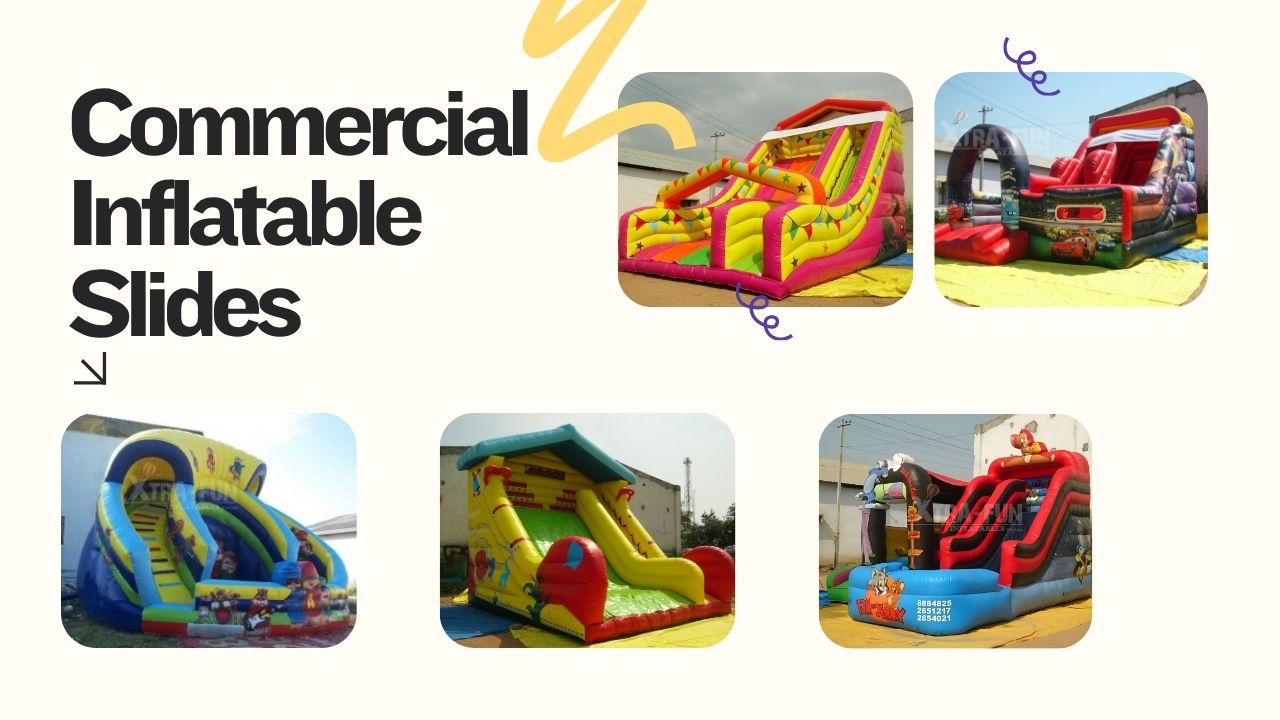
The classic inflatable slide, a dry slide, is a staple for events where water is not practical or desired. They come in a vast range of sizes, from compact models suitable for indoor venues to towering, multi-lane structures that create a significant visual impact at outdoor festivals. Themes are a popular feature, with designs ranging from castles and jungles to popular characters, making them highly attractive to family audiences. Their primary advantage is versatility, as they can be set up on grass, tarmac, or even indoors in large halls or convention centres.
Water Slides
Inflatable water slides are a premier attraction for summer events, festivals, and water-themed parks. These slides are specifically designed for use with water, incorporating features like splash pools at the bottom, sprinkler systems along the slide surface to ensure it remains slick, and heat-welded seams to prevent water from seeping into the internal chambers. The materials used are often treated with extra UV protection to withstand prolonged sun exposure and are resistant to mould and mildew. They can range from single-lane drop slides to elaborate dual-lane models that allow for racing.
Obstacle Course Slides
Combining the thrill of a slide with the engagement of an interactive challenge, inflatable obstacle courses are immensely popular for team-building events, corporate family days, and competitive races. These units integrate a slide, often as the grand finale, with a series of other inflatable elements. Participants must navigate through tunnels, climb over walls, squeeze past pillars, and bounce across platforms before reaching the final slide. This type of inflatable promotes active engagement and can be designed in various lengths and complexities to suit different age groups and fitness levels.
Themed and Character Inflatable Slides
The visual appeal of inflatable slides can be significantly enhanced through theming. These slides are designed around a specific concept, such as a pirate ship, a fairy-tale castle, a volcano, or a dense jungle. The structure itself is often moulded and printed to reflect the theme, creating an immersive experience for users. For events targeting children and families, slides featuring licensed or generic characters can be a powerful draw, instantly capturing attention and creating photo opportunities that extend the event’s reach through social media.
Custom-Branded Promotional Inflatable Slides
For corporate clients, the ultimate tool is the custom-branded slide. This goes beyond simply placing a logo on a generic inflatable. These are bespoke structures designed from the ground up to reflect a brand’s identity, a specific product, or a marketing campaign. This could involve a slide shaped like a product bottle, coloured in the brand’s exact Pantone shades, or featuring unique architectural elements that align with the company’s image. These inflatables act as giant, interactive billboards, providing an unparalleled level of brand exposure and creating a memorable and positive association in the minds of consumers.
Key Materials and Construction: What Defines Commercial-Grade Inflatable Slides?
The distinction between a consumer-grade inflatable and a commercial-grade unit lies entirely in the quality of materials and the standards of its construction. For businesses investing in these assets, understanding these technical details is crucial for ensuring safety, durability, and a positive return on investment.
Primary Material: PVC Tarpaulin
The industry standard for high-quality commercial inflatables is heavy-duty PVC (Polyvinyl Chloride) tarpaulin. This is not a single material but a composite, typically consisting of a strong polyester scrim fabric base sandwiched between two layers of PVC vinyl. Key specifications to look for include:
- Weight: Measured in ounces per square yard or grams per square metre (gsm). A common standard is 18oz (approximately 610 gsm) for high-stress areas like the bouncing and sliding surfaces, with a slightly lighter 15oz PVC sometimes used for less critical structural components like walls.
- Tensile Strength: This measures the force required to tear the material, indicating its resistance to rips and punctures.
- Safety Compliance: Reputable manufacturers use PVC that is lead-free and phthalate-free, complying with international toy safety standards. Fire-retardant properties (often meeting standards like BS 5852 in the UK or NFPA 701 in the US) are also a critical safety feature.
Stitching and Seams
The integrity of an inflatable slide is heavily dependent on its seams. A single row of stitching is inadequate for commercial use. The standard for quality construction is double or even quadruple stitching in high-stress areas. A high-strength, rot-proof nylon or polyester thread should be used. For water slides, heat-welded seams are often employed in addition to stitching. This process uses heat to fuse the PVC panels, creating a waterproof bond that prevents water from entering the inflatable’s core and causing mould or structural damage.
Internal Baffling and Reinforcement
What maintains an inflatable’s shape is its internal structure of baffles. These are strips of PVC fabric stitched inside the unit that connect the opposite walls, controlling airflow and distributing pressure evenly. Poorly designed or constructed baffling can lead to misshapen structures that are unstable and unsafe. Key stress points—such as the areas where climbing walls meet the slide, the entrance and exit points, and anchor points—should have additional layers of PVC reinforcement stitched on to prevent tearing under load.
Safety Netting and Ancillary Components
High-quality, finger-safe netting is essential at the top of slides and on any open walls to prevent users from falling out. The mesh should be fine enough that small fingers cannot get caught in it. Zips for deflation should be commercial-grade and covered with a secure Velcro flap to prevent accidental air loss. Anchor points, where the unit is secured to the ground, should be made from heavy-duty metal D-rings or similar, securely stitched into reinforced tabs.
The Business Advantage: Why Invest in Inflatable Slides for Your Organisation?
An inflatable slide is more than an amusement device; it is a powerful business tool that can deliver tangible results across various marketing and operational objectives. For organisations looking to make a lasting impression, the strategic use of an inflatable can provide a significant competitive edge.
Enhancing Brand Visibility and Recall
A large, colourful, and custom-branded inflatable slide is an unmissable landmark at any event. It acts as a three-dimensional billboard, drawing the eye from a distance and creating an instant focal point. Unlike a static banner, an inflatable is interactive and dynamic, ensuring that attendees not only see your brand but also engage with it. This high level of visibility ensures your brand cuts through the noise of a crowded event space, leading to significantly higher brand recall long after the event has concluded.
Driving Footfall and Increasing Dwell Time
In a retail environment, at a trade show, or during a community festival, the primary challenge is attracting visitors to your specific location. An inflatable slide serves as a powerful magnet, particularly for family audiences. The promise of free, fun entertainment for children can persuade families to visit your stand, store, or event area. Once there, the engagement provided by the slide increases their dwell time, providing more opportunities for your sales or marketing team to interact with the parents and convey key brand messages.
Creating Memorable, Positive Brand Experiences
Modern marketing is increasingly focused on creating experiences rather than just communicating messages. The joy and excitement a child (or adult) feels on an inflatable slide creates a strong positive emotional association with the sponsoring brand. This “halo effect” means that participants and their families will link your brand with feelings of fun, happiness, and community. These positive memories are far more impactful and lasting than traditional advertising, fostering long-term brand loyalty.
Generating Direct and Indirect Revenue
For certain business models, inflatable slides can be a direct source of revenue. Event companies, family entertainment centres, and party rental businesses can charge for use on a per-ride or wristband basis. For other organisations, the revenue is indirect but equally valuable. A shopping centre using a slide to attract families during a holiday period will see an increase in sales at surrounding retail outlets. A corporate sponsor at a festival can leverage the attraction to capture leads, conduct market research, or drive sales of a specific product.
Customisation and Branding: Transforming Inflatable Slides into a Marketing Powerhouse
The true marketing potential of an inflatable slide is unlocked through customisation. A bespoke design can elevate the structure from a simple attraction to a central component of a brand’s promotional strategy, communicating a message in a uniquely engaging way.
Bespoke Design and Thematic Integration
Customisation starts with the fundamental design. Manufacturers can create inflatables in virtually any shape or form, limited only by imagination and physics. A beverage company could commission a slide that looks like one of its drink cans or bottles. A technology firm could have an inflatable designed to resemble its latest gadget. For a film premiere, a slide could be themed around a key location or character from the movie. This level of thematic integration ensures the inflatable is not just present at an event, but is a core part of the event’s narrative.
Precision Colour Matching and Logo Placement
Brand consistency is paramount. Advanced manufacturing allows for the PVC material to be produced in specific Pantone colours, ensuring the inflatable perfectly matches a company’s brand guidelines. Logos and other brand assets can be applied in several ways. High-resolution digital printing directly onto the PVC creates a seamless and permanent finish, ideal for intricate designs. For organisations that may want to use the inflatable for different sponsors or campaigns, removable Velcro-backed panels are an excellent solution. This allows logos and messages to be easily swapped out, maximising the versatility and long-term value of the asset.
Interactive and Functional Branding
Branding can be integrated into the functional elements of the slide itself. The climbing holds on the ascent could be shaped like a company’s logo. The archway at the entrance could be designed to look like a product’s packaging. Tunnels could be printed with brand messaging, creating an immersive experience as users pass through. These subtle yet powerful details reinforce the brand identity at every stage of the user’s journey, making the engagement more profound and memorable.
Essential Safety Standards and Compliance for Inflatable Slides
For any organisation deploying an inflatable slide, safety is the number one priority. Adhering to established safety standards is not only a matter of legal and ethical responsibility but is also crucial for protecting the brand’s reputation. While specific regulations can vary, a set of internationally recognised best practices should always be followed.
Anchoring and Stability
The most critical aspect of inflatable safety is ensuring the unit is securely anchored to the ground at all times. An improperly secured inflatable can be lifted or toppled by a strong gust of wind, leading to severe accidents.
- On Grass/Soft Ground: Long, heavy-duty metal stakes should be hammered deep into the ground at every anchor point.
- On Hard Surfaces (Tarmac, Concrete): When stakes cannot be used, substantial weights must be employed. Sandbags or water barrels are common options, and the manufacturer should specify the minimum required weight per anchor point (often upwards of 165kg).
- Wind Speed: Inflatables should never be operated in winds exceeding the manufacturer’s specified limit, which is often around 15-20 mph. A calibrated anemometer should be used to monitor wind speed on-site.
Supervision and Operational Management
An inflatable slide should never be left unsupervised. A minimum of one, and often two, trained operators should be present at all times. Their responsibilities include:
- Managing the queue and ensuring a safe number of users are on the inflatable at once.
- Enforcing rules, such as no somersaults, no climbing on the walls, and ensuring users slide feet-first.
- Checking for and prohibiting sharp objects, footwear, and food or drink.
- Assisting users and being prepared to act in an emergency, including deflating the unit quickly if necessary.
Material and Electrical Safety
The inflatable itself must be constructed from safe, compliant materials. This includes fire-retardant and non-toxic PVC. The electric blower presents its own set of risks. It should be positioned away from the inflatable’s entrance and exit, with the public cordoned off from it. The power cable should be securely covered to prevent a trip hazard, and a Residual Current Device (RCD) should always be used to protect against electric shock in case of a fault or exposure to moisture. Regular inspection of the blower and its cable is essential.
Operational Logistics: Setup, Management, and Takedown
The successful deployment of a large inflatable slide requires careful planning and execution. Understanding the logistical requirements from start to finish ensures a smooth, safe, and efficient operation on the day of the event.
Site Selection and Preparation
The choice of location is the first critical step. The site must be:
- Sufficiently Large: Allow for the footprint of the inflatable plus a safety perimeter of at least 1.5-2 metres on all sides. Also, account for space for the blower, queueing, and access.
- Level and Clear: The ground should be as flat as possible. The area must be thoroughly inspected and cleared of any sharp objects like stones, sticks, or glass.
- Free from Overhead Obstructions: Check for overhead power lines, tree branches, or building overhangs.
- Protected: If possible, choose a location that offers some protection from strong winds.
A ground tarpaulin or sheet should always be laid down first to protect the base of the inflatable from abrasion and moisture.
Inflation and Securing
Setting up a commercial slide requires at least two people. The process involves unrolling the tightly packed unit onto the groundsheet, ensuring it is correctly oriented. The inflation tube is then securely attached to the blower’s nozzle. Once the blower is switched on, the structure will begin to inflate, a process that can take anywhere from 5 to 15 minutes depending on its size. As it takes shape, operators should guide the walls and towers to ensure they inflate correctly.
Once fully inflated, all anchor points must be immediately and securely fastened using the appropriate method (stakes or weights). A final walk-around inspection should be conducted to check for any issues before opening it to the public.
Takedown and Storage
The takedown process is the reverse of the setup. After ensuring all users are off, the blower is switched off. Deflation zips or ports are opened to allow the air to escape more quickly. As it deflates, operators can walk on the unit to force out the remaining air. Once flat, the inflatable must be folded neatly and systematically—often by folding the sides into the middle to create a long rectangle, which is then rolled tightly from the end opposite the inflation tubes. This ensures it fits into its storage bag and makes the next setup easier. It is critically important that the inflatable is completely dry before it is packed away to prevent the growth of mould and mildew, which can rot the stitching and damage the PVC.
Maintenance and Longevity of Inflatable Slides: Protecting Your Inflatable Investment
A commercial inflatable slide is a significant capital investment. Proper maintenance is essential to maximise its lifespan, ensure it remains safe for use, and preserve its appearance. A well-maintained inflatable can provide many years of reliable service.
Regular Cleaning
Inflatables will inevitably get dirty from foot traffic, grass stains, and spills. Regular cleaning is vital.
- Routine Cleaning: After each use, the surface should be wiped down with a soft cloth or brush and a mild cleaning solution (a mixture of gentle soap and water is usually sufficient).
- Deep Cleaning: For stubborn stains or a thorough seasonal clean, use a specialised PVC cleaner. Avoid harsh chemicals, bleach, or abrasive scouring pads, as these can damage the protective coating on the PVC and fade the colours.
- Drying: The most crucial part of cleaning is ensuring the inflatable is 100% dry before storage. If packed away damp, mould and mildew will form, which not only looks and smells unpleasant but can permanently weaken the material and seams.
Systematic Inspection
Before and after every use, a thorough inspection should be carried out. Check all seams, particularly in high-stress areas, for any signs of threadbare stitching or separation. Examine the anchor points for any tearing. Inspect the climbing surfaces and slide sheet for any punctures or abrasions. Look over the safety netting for any holes. Early detection of minor issues allows for simple repairs before they become major, costly problems.
Minor Repairs
Most professional inflatables come with a repair kit containing patches of PVC material and a suitable adhesive. Small punctures or tears can be easily repaired on-site. The area must be clean and dry. Apply the adhesive to both the patch and the area around the hole, then press the patch firmly in place, ensuring there are no air bubbles. Allow the adhesive to cure completely before re-inflating the unit. For larger tears or seam damage, it is best to consult the manufacturer or a professional repair service.
Choosing the Right Supplier for Commercial Inflatable Slides: Key Considerations for a Successful Partnership
The quality of your inflatable slide and the support you receive are directly tied to the supplier you choose. Selecting the right manufacturer or dealer is a critical business decision that goes far beyond a simple price comparison.
Portfolio and Design Capability
Examine the supplier’s past work. Do they have a diverse portfolio showcasing a range of standard and custom designs? A strong portfolio is evidence of experience and capability. For custom projects, enquire about their design process. A reputable supplier will have an in-house design team that can provide 3D mock-ups and work collaboratively with you to bring your vision to life, ensuring the final product aligns perfectly with your brand and objectives.
Material Quality and Manufacturing Standards
Do not hesitate to ask for technical specifications. A trustworthy supplier will be transparent about the materials they use, including the weight of the PVC, the type of stitching, and the quality of the components like zips and anchor points. Ask about their compliance with international safety standards, such as EN 14960 (for Europe) or ASTM standards (for the US), as adherence to these rigorous benchmarks is a strong indicator of quality manufacturing.
Warranty and After-Sales Support
An inflatable is a working asset, and issues can arise. A solid warranty is a sign that the manufacturer stands behind their product. Look for a warranty of at least one to two years that covers manufacturing defects. Beyond the warranty, consider the after-sales support they offer. Can they provide advice on maintenance? Do they offer a repair service? A supplier who acts as a long-term partner, offering support throughout the product’s lifecycle, is invaluable.
Reputation and Client Testimonials
Research the supplier’s reputation within the industry. Look for reviews, case studies, and testimonials from other businesses. A long-standing company with a history of satisfied corporate clients is generally a safer choice than a new, unproven entity offering unusually low prices. Quality, safety, and reliability should always be the primary considerations over cost alone.
Applications of Inflatable Slides Across Industries: Innovative Uses for Inflatable Slides
The appeal and versatility of inflatable slides allow them to be deployed effectively across a wide range of industries and for numerous purposes, far beyond simple entertainment.
Corporate and B2B Events
For corporate family days, team-building events, or product launches, an inflatable slide can be the centrepiece attraction. A large, branded obstacle course slide can foster teamwork and friendly competition among employees. At a product launch targeting the public, a slide themed around the new product creates an unforgettable interactive experience that generates social media buzz and positive brand association.
Festivals, Fairs, and Public Events
Event organisers use giant inflatable slides as anchor attractions to draw crowds and enhance the visitor experience. A tall, multi-lane “helter-skelter” style slide can become an iconic feature of a festival, while a water slide can be the main draw for a summer fair. Sponsors can brand these key attractions to achieve maximum visibility among a large and diverse audience.
Sports Organisations and Races
Inflatable arches are common at the start and finish lines of marathons and fun runs, but an inflatable slide can add an extra layer of excitement. A slide at the finish line provides a fun way for participants to celebrate completing the race. Sports clubs can use themed inflatables at fan zones on match days to engage younger supporters and create a family-friendly atmosphere.
Retail and Shopping Centres
Shopping centres and large retail outlets use inflatable slides to drive footfall during key sales periods like school holidays or festive seasons. By setting up a “winter wonderland” slide at Christmas or a “jungle adventure” slide during the summer, they create a destination for families. This not only increases the number of visitors but also extends their stay, leading to higher overall spending within the centre. This transforms the shopping trip from a chore into a family outing.
